
Scape — Craft Experience Marketplace
Engineering a Multi-Sided Marketplace and Partner Operations Platform
One shared platform for customer booking, partner operations and platform authority — with financial evidence embedded in the transactional core.
A marketplace is not only a customer-facing catalogue. It is a shared operating system for customers, partners and the platform team, with one booking and financial context carried across each surface.
Platform model
Three connected sides
Booking core
Nine guarded states
Capacity
15-minute bounded holds
Financial evidence
Fulfilment-gated obligations
Operations
Partner and admin consoles
Customer surface
Discovery
availability
account-free booking
Partner surface
Bookings
offerings
economics
ledger visibility
Scape operations surface
Exceptions
compliance
financial supervision
Shared transactional core
Holds
booking states
fulfilment
refunds
Financial-evidence foundation
Append-only facts
immutable context
fulfilment evidence
Supporting services: Automation · provider adapters · persistence
Three role surfaces operate over one shared transactional core and its financial-evidence foundation.
What we built
One platform, three operating perspectives
Scape brings together a browsable customer marketplace, an account-free booking path, a role-guarded partner portal and an administration console. These are complementary views of the same business state, not separate products joined after the fact.
Customers can move from category and date filtering to an experience page, session availability, a bounded seat hold and provider-hosted checkout without establishing a conventional account. Partners receive the operational visibility needed to run their offerings. Platform operators retain the authority required for financial decisions, exceptions and compliance work.
The engineering challenge
Shared state becomes difficult when authority is divided
A multi-sided platform must make different responsibilities work together without giving every role the same control. Customer trust has to work without a standing account. Capacity must withstand competing hold requests. Payment collection cannot be confused with value earned through fulfilment. And different business models create different invoicing obligations.
The engineering task was therefore not a set of pages. It was a transaction model that could project consistent information into customer, partner and administrative workflows while preserving the decisions that belong with the platform.
Payment confirmation never impersonates earned revenue.
Multi-sided platform model
Three planes, one transactional core
The customer marketplace, partner operations portal and Scape administration console sit above a shared transactional core. That core manages holds, booking state, fulfilment, refund and compliance services. Financial evidence is the foundation beneath it: recorded financial facts, immutable booking context and fulfilment evidence support the operational views above without becoming a fourth silo.
Customer surface
Discovery
availability
account-free booking
Partner surface
Bookings
offerings
economics
ledger visibility
Scape operations surface
Exceptions
compliance
financial supervision
Shared transactional core
Holds
booking states
fulfilment
refunds
Financial-evidence foundation
Append-only facts
immutable context
fulfilment evidence
Supporting services: Automation · provider adapters · persistence
Three role surfaces operate over one shared transactional core and its financial-evidence foundation.
Customer marketplace
Discovery and booking without a customer account
Browse and filter
Marketplace listings can be filtered by category and date.
Choose with context
Rich programme pages bring content, logistics, session choices and remaining-seat indicators together.
Reserve capacity
A selected session creates a row-locked, 15-minute hold, rate-bounded per IP address, before checkout.
Complete payment
Hosted Barion checkout has been verified in the provider sandbox; payment status is verified again on the server.
Manage privately
An expiring, single-booking link supports booking review and a cancellation request without creating a customer account.
Extend the surface
Verified attendees can rate completed experiences; partners have public brand pages, and editorial content is supplied through a bounded headless blog.
Transaction and booking core
Booking discipline built into the operating model
Scape uses a nine-state booking machine with guarded transitions, so a booking moves through defined operational states rather than informal status changes. Row-locked capacity holds prevent competing requests from taking the same seat allocation. Effects are idempotent across booking, hold, refund, ledger, payout and notification work, while money is represented as integer HUF with consistent totals.
Provider callbacks are re-verified server-side. Confirmation and durable outbox enqueue occur in the same transaction: the booking is never hostage to an email.
- 01A nine-state booking machine with guarded transitions.
- 02Row-locked capacity holds and bounded expiry.
- 03Idempotent effects across booking, payment, refund and notification work.
- 04Integer HUF money with consistent totals.
- 05Server-side provider verification with confirmation and outbox enqueue in one transaction.
Booking lifecycle
A controlled path from discovery to post-booking
The main path keeps customer activity legible while the core records the states that matter operationally. Cancellation, refund and rescheduling sit on a governed exception branch. An administrator-approved refund exception executes automatically after approval. The T-72 rule is a confirmation window and administrative routing rule, not a refund entitlement. Administrative rescheduling exists in the engine today; a customer-facing reschedule-first model remains designed work.
- 01
Discover
- 02
Select session
- 03
Hold
- 04
Payment
- 05
Confirmation
- 06
Fulfilment
- 07
Post-booking
Exception branch
Cancellation request or non-occurrence report → administration decision → approved refund execution; administrative rescheduling available today, customer-facing reschedule-first designed.
Partner operations platform
Strong visibility, bounded operational authority
The partner portal is an operating-console foundation, not an assertion that every partner task is self-service. Role-guarded users can see dashboard economics computed from their own bookings: GMV, a 15% commission parameter and net value, upcoming sessions and history. They can inspect attendee-level bookings, confirm holds, report non-occurrence for the administration approval chain, maintain offering details and review per-offering take-up.
The money view is equally deliberate: partners can inspect gross, commission and net in a running ledger, export their data to CSV, and review payout, commission-invoice, refund and booking invoice-compliance history. They also receive a public brand-page presence.
Partners do not decide refunds. That action was intentionally removed so transparency remains with the partner while money-deciding authority remains with Scape. Designed beyond today: self-onboarding, publishing, session creation and editing, availability tools, attendance export and persistent branding.
What partners SEE
SEE
- Actual-booking economics: GMV, commission parameter and net
- Attendee-level bookings and session occurrence views
- Gross, commission and net ledger entries
- Payout, commission-invoice, refund and compliance history
- Public brand-page output
What partners OPERATE
OPERATE
- Confirm holds
- Edit offering details
- Report non-occurrence
- Export CSV
- Review offering take-up
What stays with the PLATFORM
PLATFORM
- Refund approval and execution
- Cancellation-report decision
- Financial booking supervision
- Payout mark-paid bookkeeping
- Invoice-compliance validation, delivery or waiver
Partners receive the information and actions needed for daily operations; the platform retains money-deciding authority.
Money you can prove
Collection and earning are different rails
Collection is automated through the verified sandbox payment path. Earning recognition begins only with fulfilment. The core records append-only financial evidence, immutable booking-context snapshots, exactly-once fulfilment evidence and the resulting eight-day invoice obligation. Refund evidence records the reversal semantics of an approved exception.
Monthly settlement is designed as the next cycle, not presented as an automated payout or invoicing system. The distinction protects an essential business truth: receiving a payment is not the same as recognizing earned value.
Collection rail
Sandbox-verified- 01
Bounded hold
- 02
hosted Barion payment
- 03
server verification
- 04
confirmed booking
Earning rail
Delivered evidence- 01
Fulfilment
- 02
exactly-once fulfilment evidence
- 03
eight-day invoice obligation
- 04
append-only financial facts and immutable booking context
- 01
Monthly settlement cycle
- 02
reconciliation and money-out workflow
Collection and earning are deliberately separated; the monthly settlement segment is designed.
Scape administration
Platform authority where exceptions and financial work meet
Scape administration is the counterpart to partner visibility: two consoles, one core, separated authority. The 41-endpoint administrative surface supports financial booking reporting and CSV export, payout approval as mark-paid bookkeeping with a bank reference, refund override and post-approval execution, and cancellation-report approval or rejection.
Administrators also validate, deliver or waive invoice-compliance records; operate a VAT monitoring view, acknowledging its derivation caveat; curate editorial content; and use supervisory read views across bookings, ledger and invoice work. The payout model records an offline bank transfer decision; it does not claim banking automation.
External integrations
Provider boundaries matched to operational responsibility
Barion — Sandbox: Hungarian payment-provider integration for hosted collection, HMAC-signed callbacks and refund calls; the path is sandbox-verified.
Billingo — Bounded: Commission-invoice adapter with retry and correction handling. Scape-Direct invoicing is designed rather than delivered.
Resend via durable outbox — Bounded: Transactional email uses a provider-neutral pipeline with retry and dead-letter semantics.
WordPress — Bounded: A headless content plane supplies blog and legal-content surfaces with fallback handling.
Integrations are represented by their operational boundary and current posture.
- 01Barion [Sandbox]Hosted payment, signed callbacks, refund calls
- 02Billingo [Bounded]Commission-document adapter, retry and correction handling
- 03Resend / durable outbox [Bounded]Transactional notifications, retry and dead-letter handling
- 04WordPress [Bounded]Headless editorial and legal-content plane
- 05Scape-Direct invoicing [Designed]Future invoicing evolution
Product evidence
Interface surfaces tied to specific operating claims
Selected interface captures show the customer booking path, partner booking visibility, ledger transparency and administration-side compliance work. Each capture is framed as a local demo-data surface, redacted before publication, and used only where it substantiates a defined platform capability. If a capture does not retain that clarity, the surface inventory remains the appropriate evidence.
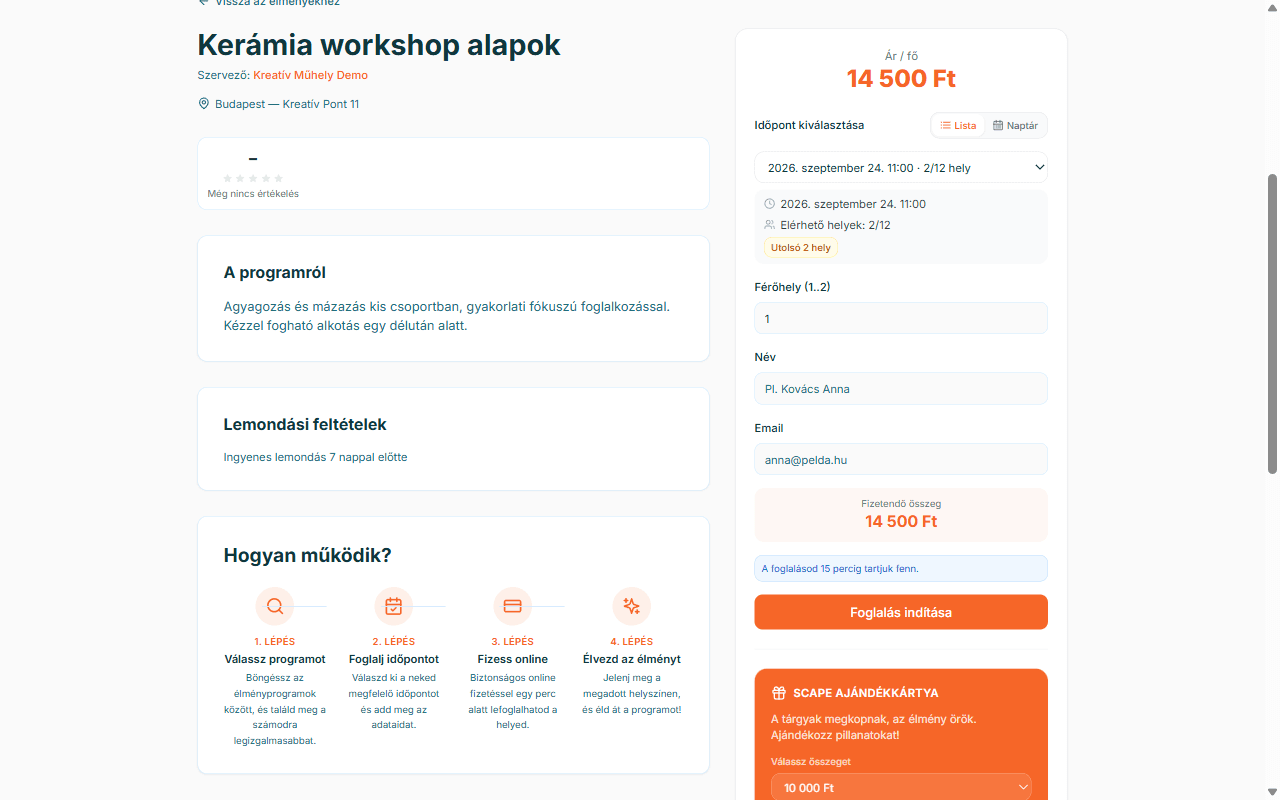
Experience detail and booking entry point with session availability. Demo data.
Seeded local demo data; no commercial-operation claim.
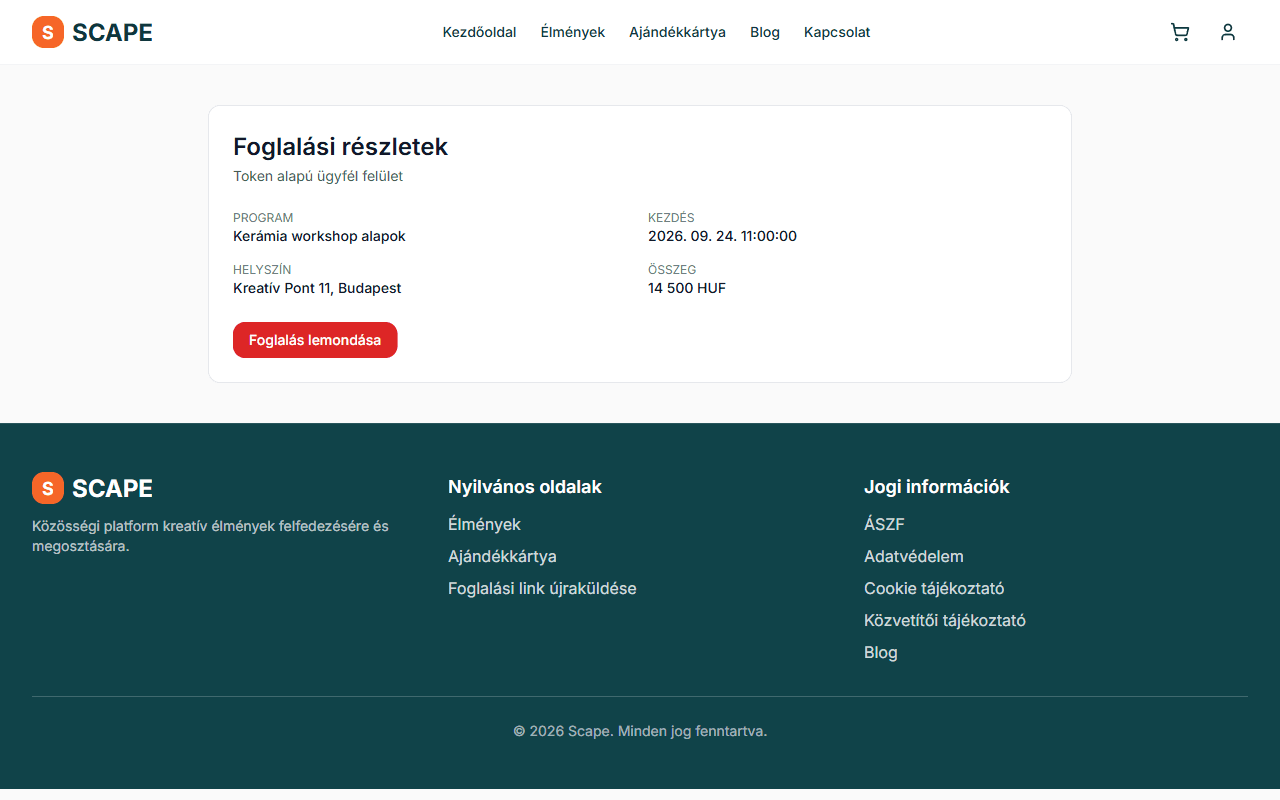
Private booking management through an expiring single-booking link. Demo data.
Seeded local demo data; token access is shown only as a bounded product capability.
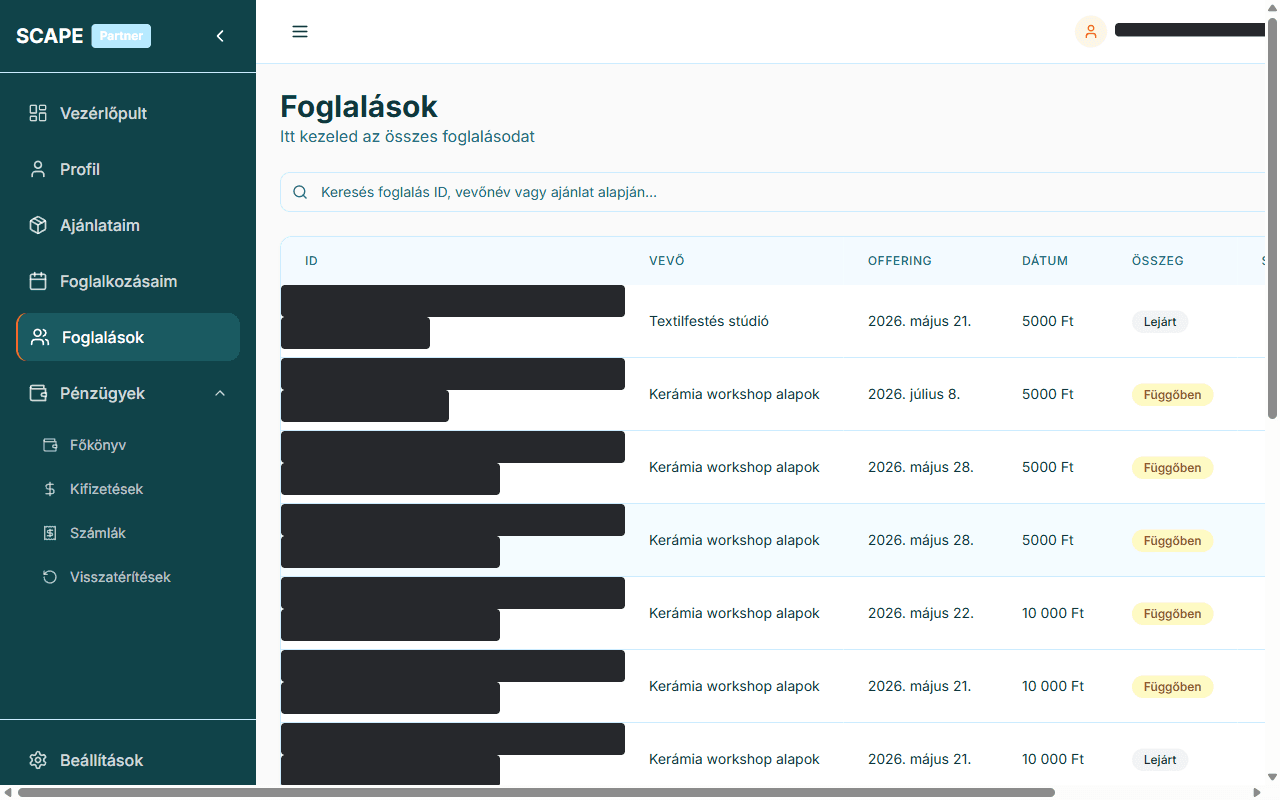
Partner booking visibility and operational handling. Demo data.
Seeded local demo data; the screen does not evidence partner refund authority.
Engineering approach
Built through a governed delivery method
Scape was developed through SALVOC’s governed AI engineering approach: architecture, implementation, independent technical review, deterministic validation and human authority were kept separate. The method is documented in the Governed AI Engineering case study; here, the focus remains the multi-sided business platform it made possible.
Current system direction
Capability maturity, stated precisely
Scape is presented in a governed local-development and sandbox posture, using seeded demonstration data; these statuses describe system capability, not commercial operation or business outcomes.
The delivered, designed and roadmap rows below distinguish established capability from the next operational increments without inflating either.
Multi-sided operating platform
Customer marketplace, role-guarded partner portal and Scape administration over one shared transactional core.
DeliveredAccount-free booking
Category/date filtering, session availability, bounded holds, sandbox-verified hosted checkout and private expiring booking links.
DeliveredPartner operations
Booking and attendee visibility, offering edits, non-occurrence reporting, ledger transparency and CSV export.
DeliveredFinancial evidence
Append-only financial facts, immutable booking context, fulfilment evidence and an eight-day invoice obligation.
DeliveredPlatform authority
Administration-side refund exceptions, cancellation-report decisions, compliance handling and offline-transfer payout bookkeeping.
DeliveredMonthly settlement cycle
A specified fulfilment-to-settlement cycle; not an automated payout or invoicing claim.
DesignedCustomer reschedule-first model
Customer-facing modification and disruption remedies, distinct from existing administrative rescheduling.
DesignedScape-Direct invoicing
Future Billingo invoicing evolution beyond the commission-document adapter.
DesignedPartner self-service completion
Self-onboarding, publishing, session tools, availability maintenance, attendance export and persistent branding.
Roadmap
Maturity separates present capability from specified next steps and longer-term platform work.
What this demonstrates for clients
Transferable capabilities for multi-sided businesses
Discovery and transaction surfaces
Customer journeys that connect filtering, availability, bounded holds and hosted payment.
Transactional state machines
Guarded state transitions and idempotent effects for workflows where operational mistakes have consequences.
Dual-console authority operations
Partner visibility paired with a platform control plane for money decisions and exceptions.
Financial-evidence architecture
Recorded financial facts, immutable context and fulfilment-gated obligations instead of payment-led assumptions.
Adapter-boundary integrations
Payment, document, email and content providers placed behind explicit operational boundaries.
These capabilities apply to booking platforms, marketplaces, supplier and partner operations, and regulated transaction environments.
Build the operating platform behind the marketplace
Building a marketplace or partner operations platform?